Case Study
How Strategic Computing Built a Modern GTM System with HubSpot and AI

About Strategic Computing
Strategic Computing is a Dublin-based consultancy led by Ray Murphy. The business helps large organisations navigate complex enterprise software procurement and commercial negotiations. Ray's clients include Barclays, Aviva, HSBC, Lloyds Banking Group, and Capgemini.
The expertise was substantial. The commercial infrastructure behind it was not keeping pace.
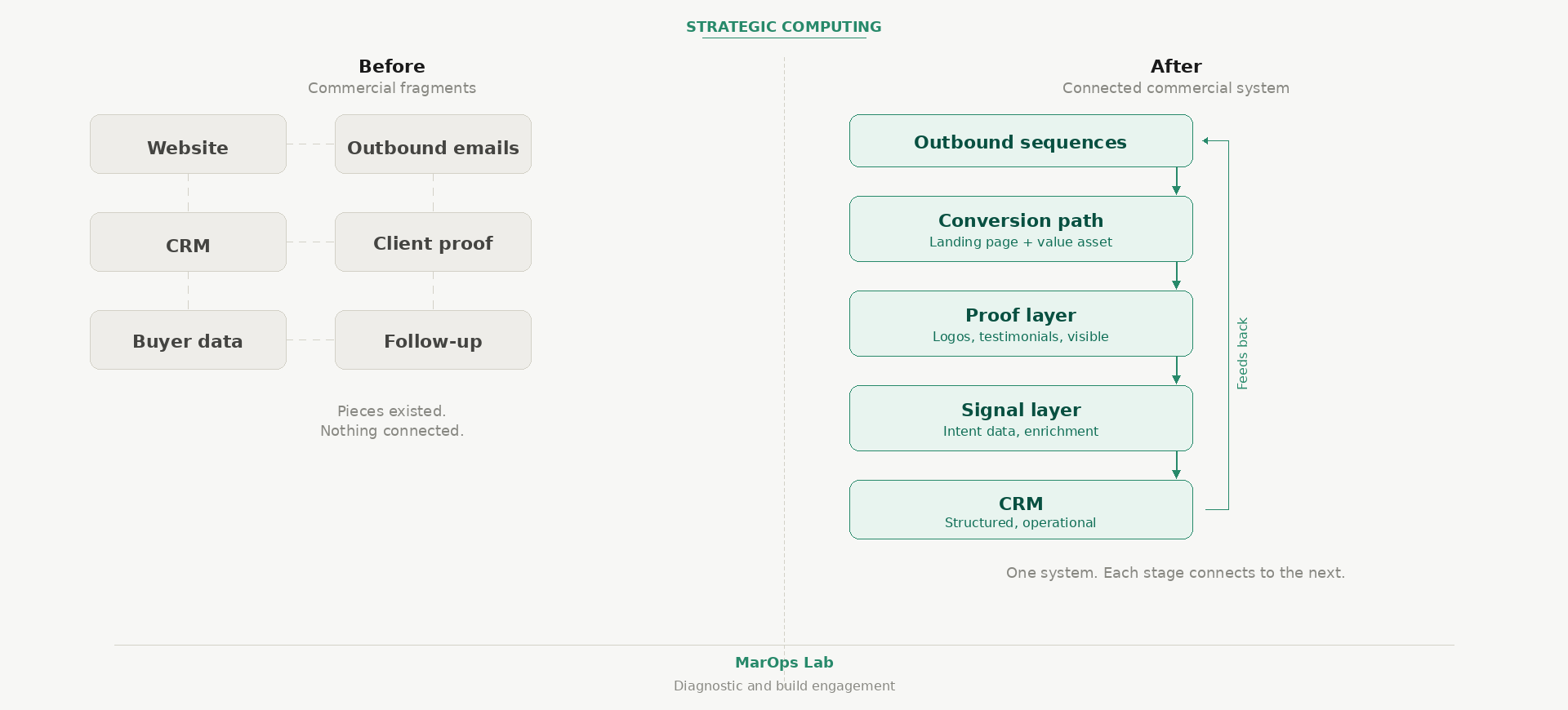
The website functioned as a brochure. Visitors could arrive and read, but there was no clear next step, no asset to anchor a conversation, no conversion path. Outbound emails went out, some opened, nothing converted. Alongside this, Ray had a significant body of client proof, testimonials and logos from household-name organisations, sitting in internal documents. None of it was visible in the market-facing journey. The business was presenting itself as smaller and less proven than it actually was.
HubSpot was live. Apollo had been used. Lists had been built. But the pieces were not connected into anything a buyer could move through.
The Challenge
The first step was not execution. It was mapping what was actually happening across the commercial system versus what was assumed to be happening.
The system was not broken in one place. It was incomplete across every stage of the commercial journey. A buyer who opened an email, visited the website, and found a static page with no clear action had nowhere to go. Outbound was carrying the full weight of a buyer journey that had no infrastructure behind it.
The diagnostic surfaced four specific gaps:
No value exchange asset to anchor outreach. No conversion path between email and conversation. No signal intelligence to identify who was actively in a buying cycle. Significant client proof invisible to the market.
The issue was not the tools. It was the absence of the system that should connect them.
The Work
MarOps Lab worked directly inside Strategic Computing's systems across three phases.
Phase 1: Diagnosis and reframe
Mapped the full commercial system before touching any tool. The diagnosis reframed the problem from 'better emails' to 'no functioning buyer journey.' Introduced intent-led commercial thinking as the operating model for everything that followed.
Phase 2: Infrastructure build
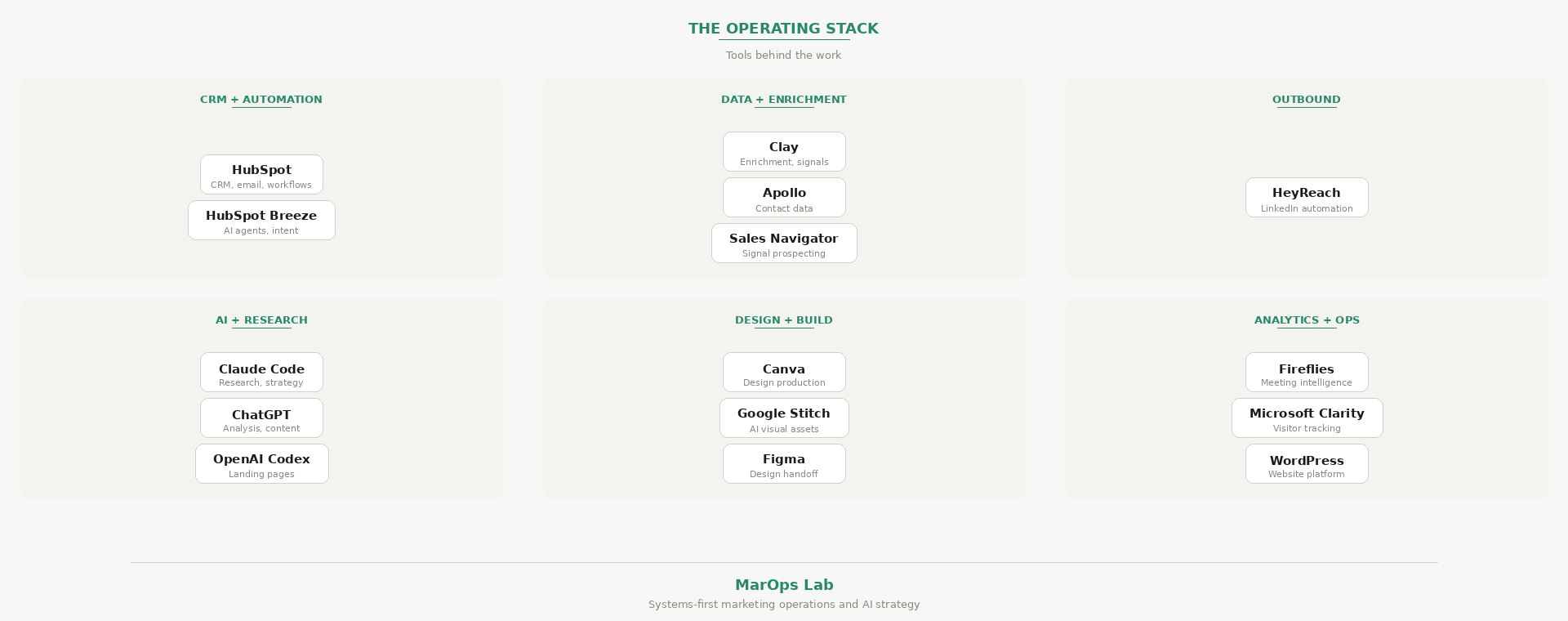
HubSpot was restructured to reflect how the business actually operates, not default configuration. Contact lists were built and validated in Clay using enrichment and procurement-specific signal data. Outbound sequences were designed across email and LinkedIn via HeyReach with clear logic at each stage. A landing page and lead asset gave outbound a proper destination. Client proof, logos, and testimonials from major UK institutions were surfaced and repositioned into the market-facing journey. Claude Code was used throughout for account research, content development, and signal analysis.
Phase 3: AI and signal layer
HubSpot Breeze smart properties and the Company Research Agent were activated for automatic record enrichment. Buyer Intent tracking was configured around enterprise software procurement, contract negotiation, and vendor evaluation keywords. The signal layer now surfaces which companies are in an active buying cycle before they make contact, giving the founder visibility into timing, not just volume.
The Outcome
Strategic Computing now operates with a commercial system built around its actual buyer journey, not a collection of disconnected tools.
Outbound runs on validated contact intelligence and structured sequences. The proof that was buried in internal documents is now visible at every touchpoint in the market-facing journey. HubSpot reflects how the business actually operates. The signal layer surfaces buying intent before a prospect makes contact.
The more durable shift was in how the commercial journey is now structured. Outreach connects to a conversion path. The conversion path is supported by a proof layer. The whole system is informed by intent signals. Each stage feeds the next.
Strategic Computing now runs, iterates, and builds on the system independently. The engagement began with diagnosis and infrastructure. That foundational work is complete and the system is live.
The tools behind the work